More than 75 years before Astoria became widely known for The Goonies, Short Circuit, and Free Willy, it was already the site of an important early motion picture: The Fisherman’s Bride (1909), directed by Francis Boggs for the Selig Polyscope Company.
On September 23, I premiered a short trailer inspired by that lost silent film, timed to coincide with the ribbon-cutting for Astoria’s new Duane Street Film Mural. That pairing felt especially fitting, since the mural honors Oregon’s screen history, including The Fisherman’s Bride.
Watch the trailer:
https://www.youtube.com/watch?v=ukNi2HzCMZI
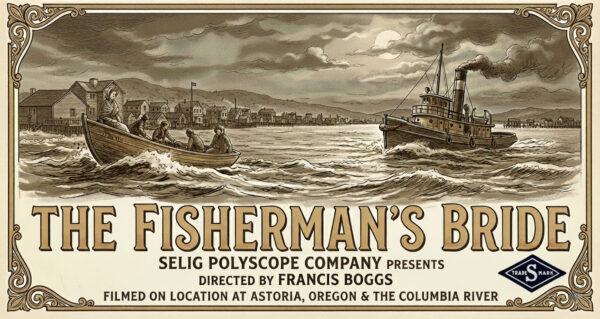
Rather than functioning as a conventional modern trailer, the piece is designed as a historical reconstruction—an attempt to imagine how The Fisherman’s Bride might have been promoted and presented to audiences in 1909. Presented in a 4:3 frame with silent-era pacing, period-style intertitles, and sepia-toned imagery, it follows the outline of the surviving story: a fisherman’s daughter, a forced romantic conflict, an abduction on the Astoria waterfront, and a river rescue by federal authorities.
Because no known print of The Fisherman’s Bride has been located, the trailer is not based on recovered footage. Instead, it was built from the surviving historical record. That record has been strengthened in part by the efforts of Mac Burns at the Oregon Film Museum, whose research helped deepen the project’s foundation. Mac has been a strong advocate for giving pioneering film producer William Selig greater recognition among modern audiences for his role in early American filmmaking. He also located a partial shot log, script notes, letters, and other related documents at the Academy Library in Los Angeles, a valuable find that helped inform the reconstruction and offered a clearer sense of how the original film may have unfolded visually.
Those materials allowed me to analyze the surviving fragments and gain a clearer understanding of the original production’s structure. The Fisherman’s Bride is widely recognized as the first known scripted commercial film made in Oregon, and yet it remains unknown outside specialized film-history circles. Its director, Francis Boggs, was one of the important early filmmakers working for Selig when American cinema was still defining itself geographically and artistically. And Astoria, with its docks, ships, and working waterfront, gave the production a setting that could not easily be replicated on a backlot.
What interested me most in creating the trailer was not simply retelling the plot, but trying to make this vanished film tangible again for a modern audience. If the original is lost, what can still be conveyed through documentation, style, and historical imagination? How do you evoke a film that survives mostly in descriptions, trade references, and scattered archival traces?
The approach I took was to treat the trailer itself as an act of interpretation—grounded in research, but meant to be experienced as cinema rather than as a footnote. To make that interpretation concrete, I reconstructed the shot list, storyboarded it, and built the trailer from there. Using historical references and contemporary technology, I recreated Astoria as it might have appeared on film in 1909.
The project also serves as a proof of concept for the much larger problem of lost history. Thousands of films from the era no longer survive in viewable form, leaving behind only reviews, synopses, production records, stills, advertisements, and other fragments of evidence. Those materials can never replace the original films, but carefully researched visual reconstructions may offer a new way to interpret and share what remains—helping modern audiences engage with works that would otherwise exist only as titles in a catalog or descriptions in an archive.
If this trailer helps bring a little more attention to The Fisherman’s Bride, to the work of Francis Boggs, and to William Selig’s place in early film history, then it has accomplished what I hoped it would.
Watch The Fisherman’s Bride trailer:
https://www.youtube.com/watch?v=ukNi2HzCMZI
Flax Glor is an Astoria-based filmmaker, author, and instructor whose work includes research into the motion-picture history of the West Coast.
